Campaign-style hat
Royal blue headwear creates a distinctive professional profile and reinforces agency recognition during formal and outdoor assignments.
Professional identity
The STEAD uniform establishes a recognizable correctional identity built around professionalism, readiness, confidence, discipline, and public service.
Uniform philosophy
The STEAD uniform is intended to reinforce a professional correctional environment. It communicates that officers possess lawful authority, operational preparedness, and a clear responsibility to protect the people and institutions placed in their care.
The design avoids an unnecessarily tactical or combat-oriented appearance during routine institutional operations. The objective is not to diminish command presence, but to ensure that command presence comes from confidence, training, consistency, and visible professionalism.
Officers remain equipped and prepared to respond decisively when circumstances require intervention. The standard daily uniform, however, is designed for the professional management of a secure public institution.
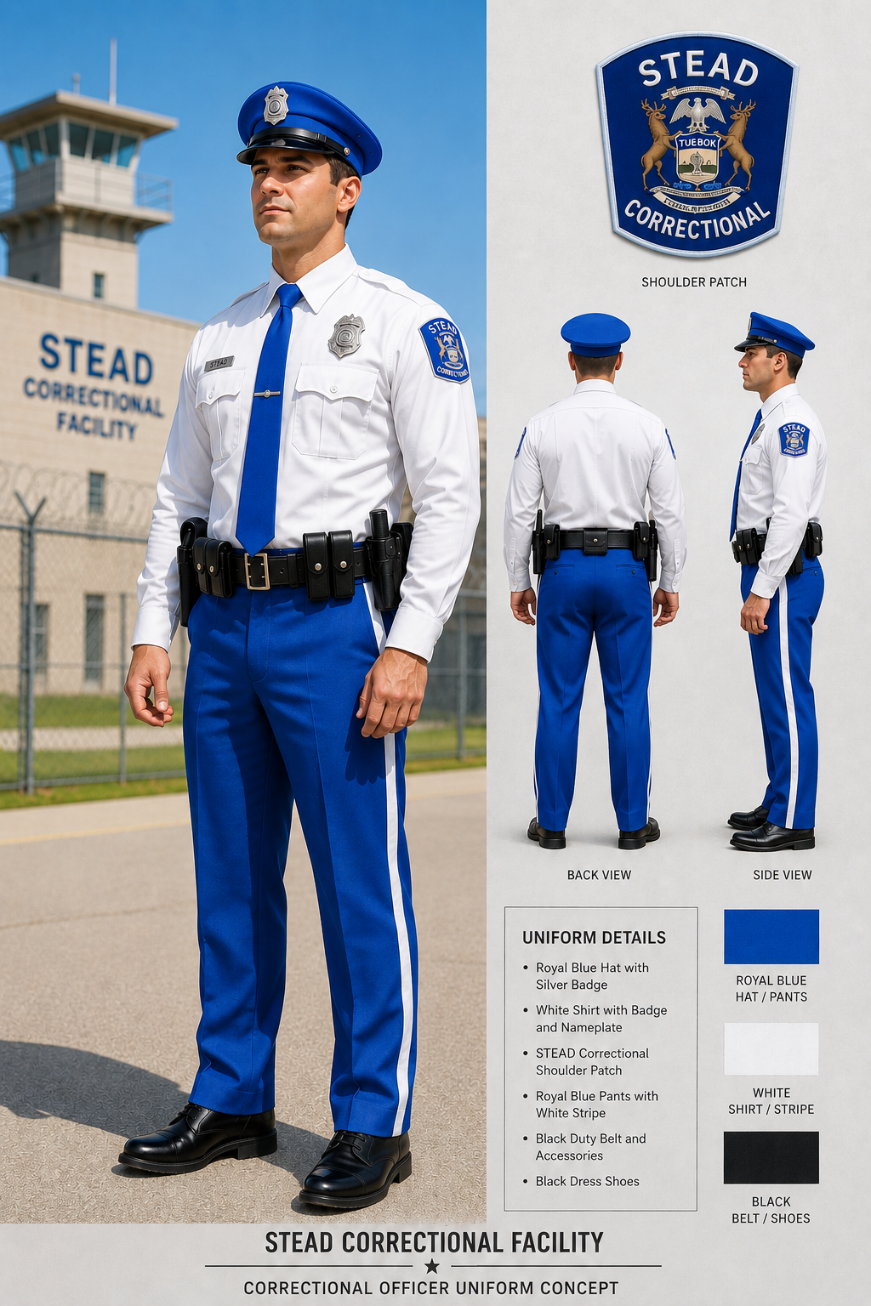
Primary duty uniform
The standard STEAD duty uniform combines a white uniform shirt with bright royal blue trousers, a white trouser stripe, a royal blue campaign-style hat, black footwear, and a black duty belt.
The design draws from traditional public-safety uniforms while maintaining a lighter and more service-oriented visual profile. It is intended to be immediately recognizable without appearing needlessly aggressive.
Research and design
The STEAD color palette is informed by research in color perception, environmental psychology, person perception, institutional design, and professional identity.
Royal blue is intended to preserve visible authority, agency recognition, stability, and public-safety professionalism. White reinforces contrast, service, order, visibility, and accountability.
Black and other dark colors remain useful for tactical equipment and specialized assignments, but they do not define the everyday visual character of the STEAD institution.
Uniform components
Final fabric, equipment, fit, placement, and manufacturing standards should be established through testing, officer evaluation, safety review, and institutional procurement.
Royal blue headwear creates a distinctive professional profile and reinforces agency recognition during formal and outdoor assignments.
A structured shirt supports a clean appearance, clear insignia placement, and visible professional standards.
Durable uniform trousers provide mobility, comfort, and a consistent agency appearance across daily assignments.
The stripe creates a formal visual line and serves as a recognizable mark of STEAD service.
Officers should remain clearly identifiable by name, employee number, badge, rank, and agency assignment.
Authorized equipment should be standardized, secured, positioned consistently, and selected according to assignment.
Why appearance matters
The uniform should communicate control, readiness, and professionalism before a word is spoken.
Correctional environments are highly structured, closely observed, and influenced by routine interactions. Officer appearance therefore contributes to institutional tone.
A clean, consistent, and recognizable uniform communicates that the institution is organized and that its officers are prepared. It also reinforces the expectation that authority will be exercised according to established standards rather than personal emotion.
The STEAD uniform is not designed to make officers appear weak. It is designed to project confidence without depending upon fear as the primary means of institutional control.
Uniform classifications
Used for ceremonies, official events, memorials, graduations, public appearances, inspections, and formal administrative duties.
Used for routine institutional operations, housing-unit assignments, transportation, supervision, and daily public-safety work.
Used when operational conditions require specialized protective clothing, medical equipment, emergency-response gear, or additional visibility.
Appearance standards
Uniform standards should apply consistently while allowing reasonable accommodation for disability, religion, medical need, climate, pregnancy, body type, and operational assignment.
Standards should focus on cleanliness, serviceability, identification, safety, and professional presentation rather than unnecessary personal conformity.
Safety and function
Final uniform standards should be tested for mobility, heat management, visibility, contamination control, emergency response, equipment retention, physical restraint hazards, laundering, durability, and extended-shift comfort. Specialized assignments may require protective clothing or equipment that temporarily replaces parts of the standard uniform.
STEAD Officer Corps
The STEAD uniform gives officers a distinct, professional identity while reinforcing the larger correctional philosophy: disciplined authority, institutional safety, public service, accountability, and respect.